New construction walls
Regular stud bays on a new build, where batts fit properly and cost per unit of R-value is hard to beat.
Batts are a sound, cost-effective choice for regular framed cavities, and on plenty of projects they are what we recommend. What separates a wall that performs from one that does not is how carefully they are fitted.
Fibreglass batts are pre-cut lengths of insulation made from fine glass fibres, sized to fit between studs, joists and trusses. They work by trapping still air within the fibres, which slows heat conducting through the assembly. They are friction-fitted into the cavity rather than fixed in place, then covered by a vapour barrier and a finish.
Our name is spray foam, but foam is not the right answer to every problem. Batts remain one of the most widely used insulation materials in Canadian construction for good reason, and on plenty of projects they are exactly what we recommend. Some jobs call for both.
Fibreglass has a deserved reputation for underperforming, and almost all of it traces back to installation rather than to the material itself.
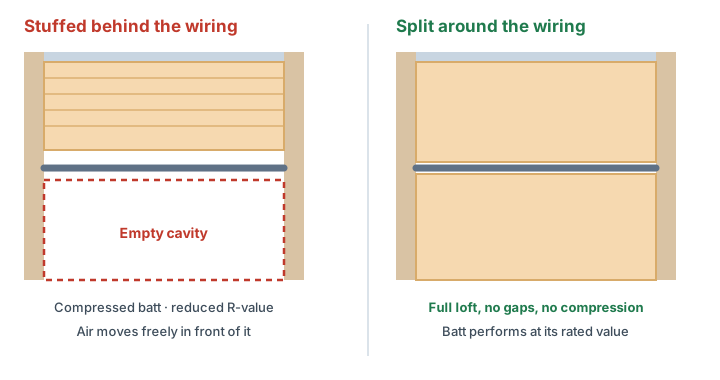
A batt works by holding still air in its fibres. Compress it and you reduce its R-value, because you have squeezed out the air that was doing the work. Leave a gap at an edge and air moves around it, bypassing the insulation entirely rather than passing through it. Neither failure is visible once the drywall is on, which is precisely why it happens so often.
Getting those details right is the difference between a wall performing at its rated value and one that does not. It is also the entire reason to pay somebody to install a material that looks, to a homeowner, as though anyone could push it into a hole.
These are consistent, easy to spot before the walls close up, and almost never spotted afterwards.
Batts do not control vapour themselves, unlike closed cell foam which resists vapour movement as part of what it is. So a batt assembly in this climate normally includes a separate vapour barrier on the warm side, and how that barrier is detailed matters as much as the batt behind it.
Sheets have to be lapped and sealed, not simply overlapped and stapled. Penetrations around electrical boxes, pipes and ducts need sealing rather than trimming around. What is required for your specific project comes from the project documents, not from a general rule, but the principle is constant: a barrier with holes in it is not performing the job it was installed to do.
Walls open at the moment? That is the one window to get this right. Once the drywall is on, nobody can see whether it was done properly.
Batts make sense in regular framed wall cavities on new construction, accessible attic floors with consistent joist spacing, interior partitions where the goal is sound rather than heat, and floors over unheated garages and crawl spaces. They also suit any project where budget is the deciding constraint and the cavities are regular enough for batts to fit properly.
They are the wrong choice where cavities are irregular, where the assembly needs air sealing as much as insulation, or where moisture is a factor. A damp basement wall is a job for closed cell foam, not for batts, and we will say so rather than take the easier order.
Mineral wool batts work on the same principle but are made from stone or slag fibres and are denser. They hold their shape better, which makes them easier to fit cleanly around obstructions, and they perform well acoustically. They generally cost more for the same area. We quote either, and we will explain which way we would lean on your project and why.
Spray foam sits in a different category because it air-seals as well as insulates. The comparison table further down sets the four options side by side, but the short version is that the cavity and the moisture exposure decide more than any general ranking of materials does.
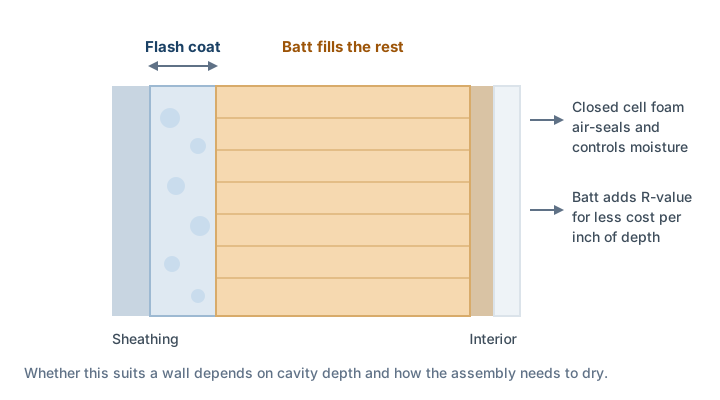
These are not competing options, and one of the most useful assemblies combines them. A thin flash coat of closed cell foam air-seals the cavity and controls moisture, and batts fill the remaining depth for R-value at a lower cost per inch.
That gets the air-sealing benefit where it matters most while keeping material cost down, which frequently makes it the best value on a wall. Whether it suits a given assembly depends on the cavity depth available and how the wall needs to dry.
Both refer to the same material. "Fibreglass" is the Canadian and British spelling and "fiberglass" is the American one, and you will see both used by suppliers and contractors across Ontario. Neither indicates anything about quality. We use the Canadian spelling throughout, while the address of this page keeps an older separated form that has been in place for a long time and is not worth changing.
The assemblies batts suit best. Whether yours is one of them is a question for an assessment.
Regular stud bays on a new build, where batts fit properly and cost per unit of R-value is hard to beat.
Attics with consistent joist spacing and room to work, where batts can be laid without gaps.
Where the goal is sound rather than heat: bedrooms, offices, bathrooms and media rooms.
Above garages and crawl spaces, where the floor is cold underfoot in winter.
Batt filling the cavity behind a thin closed cell flash coat that handles the air sealing.
Common on renovations, particularly where a room above is not holding temperature.
Office fit-outs and demising walls where acoustic separation is the requirement.
Open walls during a renovation are the one chance to insulate them properly.
Removing poorly fitted or damaged batts and installing them correctly.
| Material | How it works | Suits | Considerations |
|---|---|---|---|
| Fibreglass batts | Traps still air in fine glass fibres. Friction-fitted into framed cavities. | Regular stud bays, accessible attics, interior partitions. | Cost-effective and widely available. Performance depends entirely on fit — no gaps, no compression. |
| Mineral wool batts | Similar principle, denser material made from stone or slag fibres. | Where density, sound performance or fire behaviour is the priority. | Holds its shape well and cuts cleanly around obstructions. Generally costs more than fibreglass. |
| Blown-in loose fill | Blown to a measured depth, settling into a continuous layer. | Open attic floors, and cavities where batts cannot be fitted cleanly. | Better coverage around irregular framing. Not suitable for open vertical cavities. |
| Spray foam | Expands in place, air-sealing and insulating in one application. | Irregular cavities, damp locations, shallow walls, assemblies needing air sealing. | Higher cost. Chosen when air sealing or moisture control is the actual problem. |
Comparing quotes? Ask each contractor for the material and thickness in writing. Without both, two numbers are not comparable.
Six steps, and the last one happens before the walls are covered rather than after.
What the project is, what stage it is at, and whether batts are actually the right material for the cavities involved.
We measure the cavities, check the framing spacing and look at moisture exposure and access.
Batt type and thickness for the cavity, or an honest recommendation for a different material where batts are the wrong answer.
Scope, material and what is included, so it can be compared properly against other quotes.
Batts cut to fit, split around services rather than compressed behind them, friction-fitted to full cavity depth, with vapour barrier detailed and sealed.
We walk the work with you before it is covered, because once the drywall is on nobody can see whether it was done properly.
The assessment is free. So is the written quote, including when the recommendation is a different material entirely.
We do not publish prices. A figure quoted without seeing the project would be misleading, because two jobs covering the same area can differ substantially on the factors below.
On batt work, labour tends to move the number more than material does. A clean new build with regular framing and nothing in the cavities goes quickly. A retrofit with irregular spacing, services running through every bay and existing material to strip out is a different job at the same square footage.
Get a figure based on your actual project. We assess, then put the material, thickness and scope in writing at no charge.
We work right across the Simcoe County area, close enough to come back if something needs a second look.
Residential and commercial, new builds and retrofits alike.
Split around services, full depth, no compression, no gaps at the edges. That is what you are paying for.
Our name is spray foam, and we still recommend batts when batts are right for the cavity.
Material and thickness stated in writing, so two quotes can actually be compared.
Where a flash coat of foam plus batts beats either on its own, we will tell you.
We work throughout Simcoe County from our base in Barrie: Innisfil and Bradford in the south, Orillia and Midland to the north, Alliston to the southwest, and Collingwood and Wasaga Beach toward Georgian Bay, plus surrounding townships. Batt work follows new construction, so it comes up most in the growing subdivisions around Bradford and Alliston, while older housing further north more often calls for a combined approach — Alliston and Orillia are the two ends of it.
Spray foam insulation handles the cavities and conditions batts cannot, and pairs with them in flash-and-batt assemblies. Attic insulation is usually the highest-return work on an older house. Where foam is left exposed, our fireproofing service covers the protective covering that assembly may need. See all services.
Batts are frequently the honest recommendation rather than the fallback one — the jobs we talk people out of covers the situations where they beat foam on value. Where the two are compared directly, closed cell or open cell sets out what actually decides the material, and what drives the price explains why comparing quotes on the headline number tells you very little.
We install batts on new builds and retrofits across Simcoe County, out of Barrie, and they come up most often on the newer subdivision stock around Bradford and Alcona, where the framing is regular and the cavities are dry.
Fibreglass batts are pre-cut lengths of insulation made from fine glass fibres, sized to fit between studs, joists and trusses. They work by trapping still air within the fibres, which slows heat conducting through the assembly. They are friction-fitted into the cavity rather than fixed, and are usually covered by a vapour barrier and then drywall. Batts remain one of the most widely used insulation materials in Canadian construction because they are cost-effective, widely available and, when the cavity suits them and they are fitted properly, perfectly effective.
They solve different problems, and a contractor who always recommends the same one is not assessing your building. Spray foam air-seals as well as insulates, which suits irregular cavities, damp locations, shallow walls and assemblies where air leakage is the actual issue. Fibreglass batts are cost-effective and perform well in regular framed cavities when installed correctly. Many projects use both — a flash coat of foam for air sealing with batts filling the rest of the depth. The cavity, the moisture exposure and the budget decide, not a preference.
Because batt performance is almost entirely determined by fit. A batt works by holding still air in its fibres, so compressing it reduces its R-value, and leaving a gap at an edge lets air move around it and bypass the insulation entirely. Most of fibreglass's poor reputation traces to installation faults rather than to the material: batts stuffed behind wiring, cavities left short at the top, friction fit too loose so the batt sags away from the sheathing, and vapour barrier torn or unsealed at the seams.
Both refer to exactly the same material. "Fibreglass" is the Canadian and British spelling; "fiberglass" is the American one. You will see both used by suppliers, manufacturers and contractors across Ontario, and neither indicates anything about quality. We use the Canadian spelling in our writing, and the URL of this page uses an older separated form that we have kept deliberately because it has been in place for a long time.
It varies by product and thickness, and the honest answer is that the figure printed on the packaging is what the batt achieves when it is installed at full loft with no gaps and no compression. That last part is the whole point. A batt rated for a given value and then squashed into a shallower cavity does not deliver that value, and neither does one with an air gap behind it. We state the product and thickness in the written quote so you know what is being installed rather than what is being hoped for.
Assemblies in this climate generally need vapour control on the warm side, and batts do not provide it themselves — unlike closed cell foam, which resists vapour movement as part of what it is. So a separate vapour barrier is typically part of a batt assembly, and how it is detailed matters as much as the batt. Torn sheets, unsealed laps and penetrations left open around boxes and pipes undermine the assembly. What is required for your specific project comes from the project documents rather than from a general rule.
Often yes, provided the existing material is dry, clean and uncontaminated, and provided the air sealing has been addressed first. Adding batts over damp, compacted or rodent-contaminated material simply buries the problem and makes it harder to reach later. It is also worth checking that the existing insulation is not blocking the eave vents, because adding more on top of a blocked path makes ventilation worse. We look at what is up there before recommending topping up rather than removing.
Mineral wool batts work on the same principle as fibreglass but are made from stone or slag fibres and are denser. In practice they hold their shape better, which makes them easier to fit cleanly around obstructions, and they perform well acoustically. They generally cost more than fibreglass for the same area. Which of the two suits a project comes down to what the assembly is being asked to do and the budget available. We are happy to quote either and to explain why we would lean one way on your project.
They can be used in some basement assemblies, but a basement is exactly where batts are most often the wrong choice. Below-grade walls have a moisture exposure that batts do not address, and a batt held against a cool concrete wall in a humid summer is an assembly worth thinking carefully about. Closed cell foam is usually the better answer against foundation walls because it handles insulating and moisture control together. If you are finishing a basement, this is a question worth asking before the framing goes up.
A hybrid assembly that uses both materials for what each does best. A thin flash coat of closed cell spray foam is applied against the sheathing to air-seal the cavity and control moisture, then fibreglass batt fills the remaining depth to add R-value at a lower cost per inch than foam. It captures most of the air-sealing benefit of full-depth foam while keeping material cost down, which frequently makes it the best value on a wall. Whether it suits your assembly depends on cavity depth and how the wall needs to dry.
Yes, and that is a legitimate reason to install them in interior walls that have no thermal requirement at all. Batts in a partition absorb sound travelling through the cavity and noticeably reduce transmission between rooms. It will not make a wall soundproof — nothing short of a properly designed acoustic assembly does that, and mass and decoupling matter as much as the cavity fill — but it is a real and inexpensive improvement. Bedrooms, bathrooms, home offices and media rooms are the usual candidates.
A batt that is correctly friction-fitted to the full depth of the cavity should stay where it was put. Sagging is normally an installation issue rather than a material one: a batt cut slightly too narrow, or one that was compressed and has not recovered, can pull away from the framing and leave an air gap at the top of the cavity. That gap matters, because air moving in it bypasses the insulation. It is another reason the fit at installation determines what you get for the following decades.
Handling fibreglass causes well-known short-term irritation to skin, eyes and airways, which is why installers wear appropriate protective equipment and why the work area is kept contained. We are not in a position to give you health advice, and we would not offer any. What we can tell you is how we handle it: trained installers with proper protective equipment, the work area contained, and offcuts and packaging removed from site rather than left for you. If you have specific health concerns, raise them and we will work around them.
Both. Residential work covers new construction walls, accessible attics, floors over unheated space, interior partitions and renovations where the walls are open. Commercial work is often acoustic rather than thermal — office fit-outs, demising walls and partitions where separation between tenancies is the requirement — and is usually coordinated with other trades on a schedule. Agricultural buildings tend to call for foam rather than batts, because there is frequently nothing to hold a batt in place.
We work across the Simcoe County area from our base in Barrie, covering Innisfil, Orillia, Midland, Alliston, Bradford, Collingwood and Wasaga Beach along with the surrounding townships, and the lakes immediately north of the county for cottage and waterfront work. Staying close enough to attend quickly, and to come back if something needs a second look, is part of doing the work properly. If you are unsure whether your address is covered, call and ask.
Tell us what stage the project is at and what the cavities look like, and we will tell you whether batts are the right material for it. Sometimes they are not, and we will say so before you have spent anything.
The more you tell us, the more useful the first visit will be. If you would rather talk it through, call 705-571-3008 .
It has reached our inbox and we will get back to you shortly, usually the same working day. If it is urgent, call 705-571-3008.