Attics and roof decks
Where air sealing at the ceiling plane matters as much as the depth of material above it.
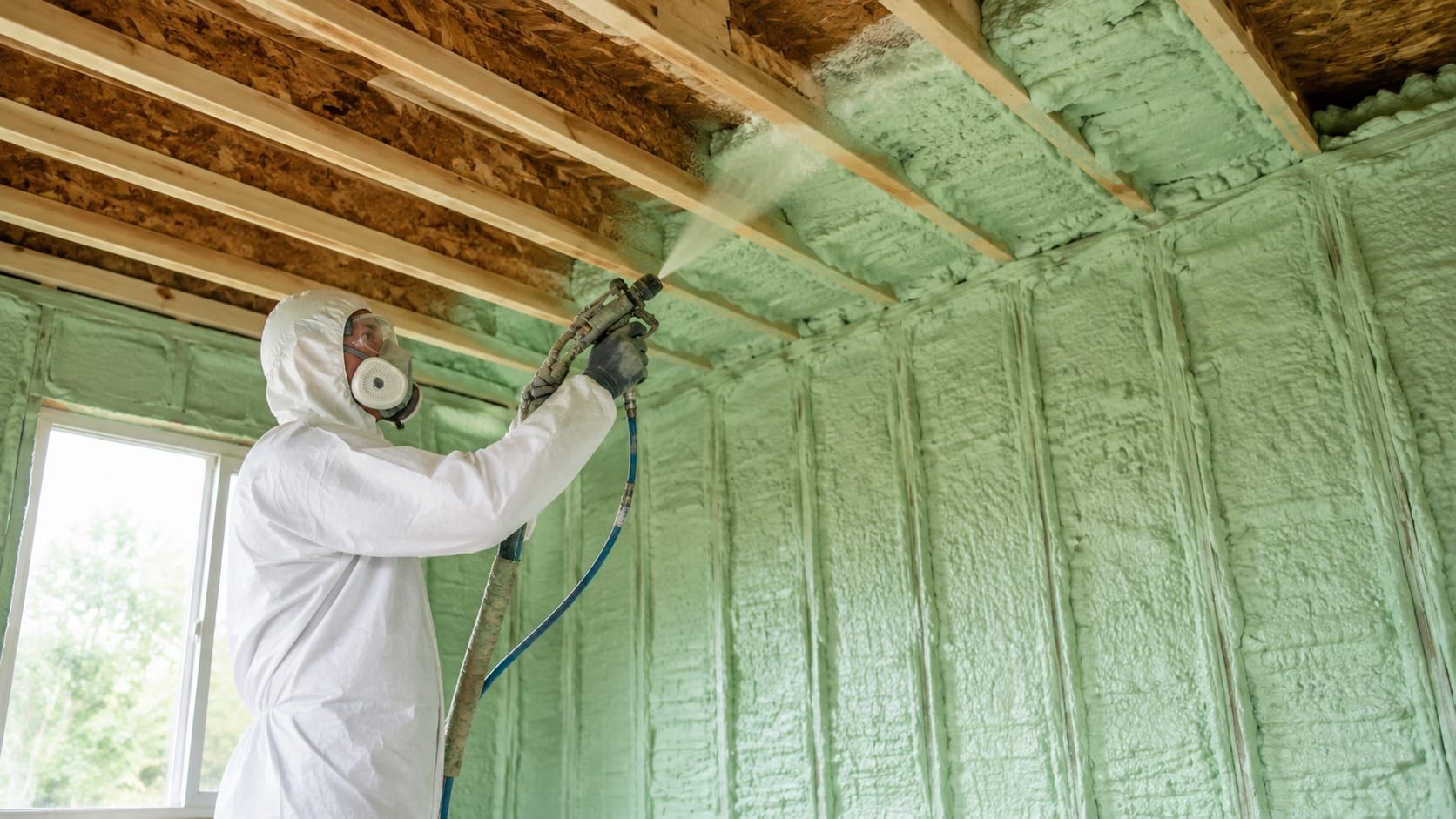
Spray foam air-seals and insulates in a single application, reaching the gaps batts bridge over. We assess the cavity, the substrate and how the assembly needs to dry before recommending which foam suits your building.
Spray foam is applied as a liquid and expands in place, filling the cracks, gaps and irregular cavities that cut sheet and batt insulation cannot reach. Once cured it forms a continuous layer that both insulates and air-seals, which is why it behaves so differently from traditional insulation in a real building.
It is installed by trained applicators using specialised equipment, because the two components have to be mixed and applied under controlled conditions. That is also why it is not a material you can meaningfully compare on price per bag against something you could install yourself.
Most people think about insulation in terms of R-value, and R-value matters. But in a Simcoe County winter the thing you actually feel is usually air moving through the building envelope rather than heat conducting through it.
Wind washing through a rim joist, or warm air escaping through an unsealed attic hatch, will undermine an otherwise well-insulated assembly. You can add depth to a ceiling indefinitely and still have a cold room below it if the air path is open. Sealing that path is the part spray foam does that other materials do not, and on most of the houses we look at it accounts for more of the discomfort than the wall assembly ever did. There is a longer version of this argument in why air sealing matters more than R-value, including the two places it shows up first — the attic plane and the rim joist.
These are two genuinely different materials, and the right one depends on the assembly rather than on which is better in the abstract.
Closed cell foam is dense and rigid, typically delivering somewhere in the range of R-6 to R-6.5 per inch. Its cells are sealed, so it resists moisture movement and adds rigidity to the assembly. That makes it the usual choice for basements, crawl spaces, rim joists and anywhere in contact with concrete or exposed to damp.
Open cell foam is lighter and softer, generally around R-3.5 to R-3.8 per inch. It expands more for the same volume of material, which helps it fill awkward cavities, and it stays vapour-permeable so an assembly can dry inward. It is commonly used in interior walls and in some attic applications, and it damps sound noticeably better than closed cell. If you are weighing the two before you call anyone, closed cell or open cell goes through the assemblies where each one is the obvious answer.
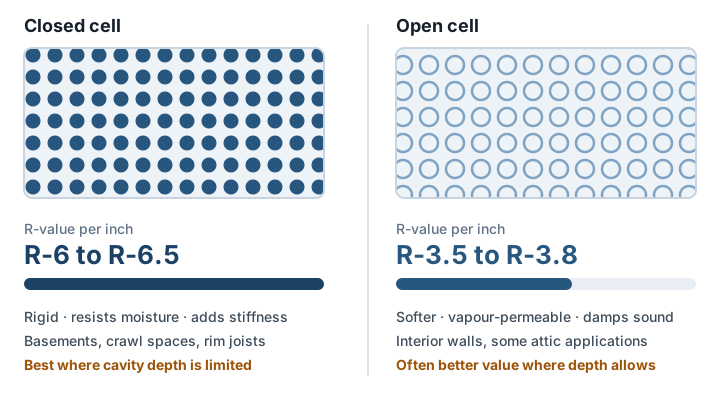
Because closed cell delivers close to twice the R-value per inch, it is the practical answer wherever cavity depth is the binding constraint. A shallow wall in a converted cottage cannot reach a useful total with a lower-density material, no matter how well it is installed.
Where depth is not the constraint, that advantage matters much less, and open cell often makes more sense per dollar. This is the single most useful question to establish early, and it is why the assessment starts with measuring what you actually have to work with rather than with recommending a product.
The moisture that damages building assemblies most often arrives as humid indoor air leaking through gaps, not as bulk water. Sealing those gaps is therefore usually a moisture improvement as well as a thermal one.
But direction matters. Every assembly needs to be able to dry somewhere, and making a wall airtight without thinking about which way it dries is how problems get created rather than solved. Closed cell resists moisture movement; open cell stays permeable. Choosing between them on an older wall is a judgement call, and it is the main thing we are weighing during an assessment on a retrofit. What I check before anything gets sprayed sets out the questions that decide it, and when spray foam is not the answer covers the buildings where the honest recommendation is a different material altogether.
Not sure which foam your building needs? That is the assessment's job. We measure the cavity, look at the substrate and tell you which suits it.
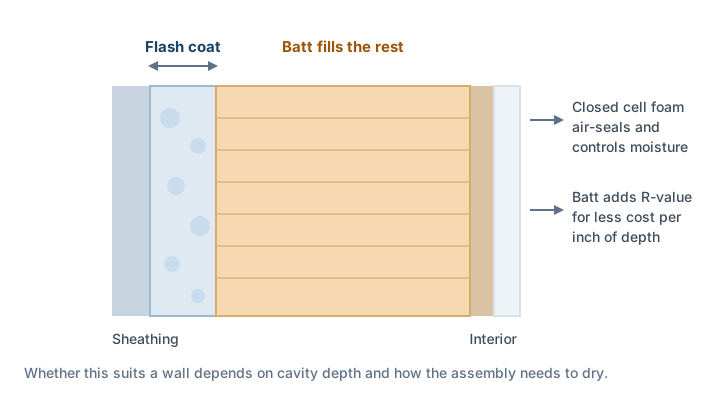
Foam and batts are not competing options, and one of the most useful assemblies combines them. A thin flash coat of closed cell foam against the sheathing air-seals the cavity and controls moisture, and fibreglass batt fills the remaining depth to add R-value at a lower cost per inch.
That captures most of the air-sealing benefit of full-depth foam while keeping material cost down, which frequently makes it the best value on a wall. Whether it suits a given assembly depends on the cavity depth available and how the wall needs to dry, so it is something we assess rather than apply by default.
The assemblies where foam earns its cost most often. Whether it suits yours is a question for an assessment.
Where air sealing at the ceiling plane matters as much as the depth of material above it.
Closed cell against foundation walls, handling insulation and moisture control together.
Usually the reason the floor above is cold, and rarely a space anyone wants to board out.
A small area responsible for a disproportionate share of leakage, and cheap to fix well.
Tight assemblies where getting a batt to sit correctly is difficult or impossible.
Open walls are the one chance to fix an assembly properly rather than work around it.
Mechanical rooms, service voids and exposed structure, often to a project specification.
Steel and post-frame structures, where foam adheres directly and controls condensation.
The room over the garage that never holds heat, which is usually a floor and rim problem.
The area is prepared and masked, and anything not being sprayed is protected. Foam is applied in controlled passes to the specified thickness — depth is what determines R-value, so it is measured rather than estimated. The foam expands and cures within minutes. Overspray is trimmed back flush where the cavity needs to accept drywall or strapping.
Occupants and pets need to be out of the work area during application and for the ventilation period afterwards. We tell you how long that is for your specific job before we start, since it depends on the product and the space, and we would rather you could plan around it than be surprised on the day.
Foam plastic insulation generally cannot be left exposed to an occupied space. Requirements normally call for it to be separated by an approved covering, most often drywall, or a sprayed coating rated for the purpose where drywall is impractical.
Where that applies to your project we will cover it in the estimate rather than leaving it as a surprise after the foam is in. It is work we carry out — see our fireproofing and thermal barrier service for how the covering is assessed, specified and applied.
| Material | How it works | Suits | R-value per inch | Considerations |
|---|---|---|---|---|
| Closed cell spray foam | Dense, rigid foam that air-seals, resists moisture movement and adds stiffness. | Basements, crawl spaces, rim joists, shallow cavities, anywhere damp. | Roughly R-6 to R-6.5 per inch | The answer where depth is limited. Higher cost per inch, lower cost per R. |
| Open cell spray foam | Lighter foam that air-seals, stays vapour-permeable and damps sound well. | Interior walls, some attic applications, awkward cavities with depth to spare. | Roughly R-3.5 to R-3.8 per inch | Often better value per dollar where cavity depth is not the constraint. |
| Fibreglass batts | Pre-cut material friction-fitted into regular framed cavities. Insulates only. | Regular stud bays, accessible attic floors, interior partitions. | Varies by product and thickness | Cost-effective when the cavity is regular. Performance depends entirely on fit. |
| Flash-and-batt | A thin closed cell layer for air sealing, with batt filling the remaining depth. | Walls where full-depth foam is not warranted but air sealing still matters. | Combines both | Frequently the best value on a wall. Suitability depends on how the assembly dries. |
Comparing quotes? Ask each contractor for the material and the target thickness in writing. Without both, two quotes are not comparable.
The same six steps on a crawl space as on a commercial envelope.
What the building is doing and where. A short conversation usually narrows it to a few likely causes.
We look at the assembly: cavity depth, substrate, moisture exposure, access and how the space is used.
Closed cell, open cell, a hybrid assembly or another material entirely, with the reasoning set out rather than asserted.
Scope, material, target thickness and what is included, so you can compare it against anyone else you ask.
The area is masked and protected, then foam is applied in controlled passes to the specified depth and trimmed back where the cavity has to accept finishes.
We show you the completed work and confirm how long the space needs to be ventilated and unoccupied before it is used again.
The assessment is free. So is the written quote, including when the recommendation is a smaller job than you expected.
We do not publish prices. A figure quoted without seeing the building would be misleading, because two jobs covering the same area can differ substantially on the factors below.
Material and thickness dominate. Closed cell costs more per inch than open cell but less per unit of R-value, so the cheaper material is not always the cheaper job. Access and preparation are the other swing: an open wall in a gut retrofit is a very different proposition from a crawl space you have to work in on your back. If you are comparing quotes from more than one company, what actually drives the price of a spray foam job explains which lines on them are worth reading closely — and it applies whether or not one of the quotes is ours.
Get a figure based on your actual building. We assess, then put the material, thickness and scope in writing at no charge.
We work right across the Simcoe County area, close enough to come back if something needs a second look.
Residential and commercial, new builds and retrofits alike.
Cavity depth, substrate and moisture exposure change the answer, so we look before recommending.
Our name is spray foam. If batts suit your cavity better, that is what we will quote.
Material and target thickness stated in writing, so you can compare like for like.
Insulation, air sealing, moisture and any covering are one problem. We look at all of it.
We work throughout Simcoe County from our base in Barrie: Innisfil and Bradford in the south, Orillia and Midland to the north, Alliston to the southwest, and Collingwood and Wasaga Beach toward Georgian Bay, plus surrounding townships. Shallow cavities in converted cottages around Wasaga Beach and Collingwood are the classic case for closed cell; newer subdivision housing further south more often needs targeted work at rim joists and bonus rooms. See Wasaga Beach and Bradford for the two ends of that range.
Attic insulation is usually the highest-return work on an older house, and often the place to start. Fibreglass batts pair with foam in flash-and-batt assemblies or stand alone where the cavity suits them. Where foam is left exposed, our fireproofing work covers the required covering. See all services.
Spray foam is applied as a liquid and expands in place, filling the cracks, gaps and irregular cavities that cut sheet and batt insulation cannot reach. Once cured it forms a continuous layer that both insulates and air-seals. That combination is what makes it behave differently from traditional insulation in a real building: most materials slow heat conducting through them, while foam also stops air moving through the assembly. It is installed by trained applicators using specialised equipment, because the two components have to be mixed and applied under controlled conditions.
Neither is better in general — they suit different assemblies. Closed cell is dense and rigid, delivers roughly R-6 to R-6.5 per inch, and resists moisture movement, so it is normally used in basements, crawl spaces, rim joists and anywhere in contact with concrete or exposed to damp. Open cell is lighter, delivers roughly R-3.5 to R-3.8 per inch, stays vapour-permeable so an assembly can dry inward, and absorbs sound noticeably better. Where cavity depth is limited, closed cell is usually the practical answer. Where depth is not the constraint, open cell often makes more sense per dollar.
As a general industry range, closed cell foam is around R-6 to R-6.5 per inch and open cell around R-3.5 to R-3.8 per inch. The figure that matters for your project is the total, which is thickness multiplied by that rate, so the depth applied is what determines the result. That is why we measure thickness during application rather than estimating it, and why the target depth is stated in the written quote. We will not promise a specific whole-assembly performance figure for your building without knowing the assembly.
Very often, yes. Foam plastic insulation is combustible, and requirements generally call for it to be separated from an occupied space by an approved covering rather than left bare. Drywall is the usual solution and frequently the cheapest. Where drywall is impractical, a sprayed covering achieves the separation without framing and boarding every surface. Whether a covering is required in your particular space, and what is acceptable there, comes from your project documents and the requirements applicable to the building. Our fireproofing page covers this in detail.
Sometimes, but it is often the wrong move. Spray foam needs to bond to a clean, sound substrate, and applying it over compressed, damp or contaminated insulation traps whatever is underneath rather than fixing it. In attics especially, removing the old material first is frequently the better outcome, because it also gives proper access to the ceiling plane for air sealing. We assess this on site rather than assuming, and we will tell you when removal is genuinely worth the additional cost and when it is not.
The foam cures within minutes, but the area needs to be ventilated and unoccupied for a period after application. We will not publish a single figure here, because the correct interval depends on the specific product and the space, and giving you a number that turns out to be wrong would be worse than giving you none. We confirm it for your job before work begins, so you can plan around it. Occupants and pets need to be out of the work area during application and for that ventilation period.
Air sealing is the main thing spray foam does that batt insulation does not, so it addresses drafts caused by air leaking through the assembly being sealed. It cannot fix drafts coming from somewhere else. A leaking window frame, an unsealed exterior door or an open chimney damper will still leak after the attic or the rim joist has been foamed. That is why the assessment looks at where the air is actually moving rather than assuming the answer, and occasionally why we recommend a smaller job than the one you called about.
Yes, and a good deal of our work happens through the cold months, which is when people notice the problem. Conditions do matter: the substrate temperature and the ambient conditions during application affect how the product behaves, and every product has a range stated by its manufacturer. Working within that range is part of installing it properly. In practice this affects scheduling and preparation more than it affects whether the job can be done, and we will tell you if conditions mean a job should wait.
Correctly specified, it usually solves them, because the moisture that damages assemblies most often arrives as humid air leaking through gaps rather than as bulk water. Incorrectly specified, it can create them, which is why the choice between closed and open cell is not cosmetic. Closed cell resists moisture movement; open cell stays permeable so an assembly can dry inward. Making a wall airtight without thinking about which direction it needs to dry is how problems get created. That is a judgement call, and it is the main thing we are assessing.
It is the wrong choice more often than a spray foam company is usually willing to say. Regular framed cavities with good access are frequently served just as well by batts at lower cost. An assembly that needs to dry in a particular direction may be better with a permeable material. Some substrates are unsuitable without preparation. And on many houses the money is better spent on air sealing a few specific locations than on foaming a whole building. We would rather tell you that at the assessment than after the invoice.
A hybrid assembly. A thin layer of closed cell foam is applied against the sheathing to air-seal the cavity and control moisture, then fibreglass batt fills the remaining depth to add R-value at lower cost per inch. It captures most of the air-sealing benefit of full-depth foam while keeping material cost down, which frequently makes it the best value on a wall. Whether it suits a particular assembly depends on the cavity depth available and how the wall needs to dry, so it is assessed rather than applied by default.
Cured foam is not a consumable in the way loose fill can be. It does not settle, slump or compress the way materials resting under their own weight eventually do, and it stays bonded to the substrate it was applied to. What can change is the assembly around it — a roof leak, a renovation that cuts through it, or services run through it later. We will not attach a specific number of years to it, because that would be a warranty claim rather than a description, and we do not make warranty claims on this site.
Closed cell foam is rigid and adds stiffness to the assembly it is bonded to, which is one reason it is used on steel and post-frame agricultural buildings. That is a real property of the material, but it should not be read as a structural upgrade to your building. Any structural question about a building belongs with an engineer, not with an insulation contractor, and we do not offer engineering services. If your project depends on a structural determination, get that answer from someone qualified to give it.
Yes. Commercial work covers mechanical rooms, service voids, exposed structure and warehouse envelopes, often to a specification issued with the project. Agricultural buildings are genuinely different work: large uninterrupted spans, steel or post-frame construction rather than stud framing, condensation control under a metal roof, and sometimes a need for a surface that tolerates washdown. Closed cell foam suits many of these buildings because it adheres directly to steel and there is frequently nothing to hold a batt in place.
We work across the Simcoe County area from our base in Barrie, covering Innisfil, Orillia, Midland, Alliston, Bradford, Collingwood and Wasaga Beach along with the surrounding townships, and the lakes immediately north of the county for cottage and waterfront work. Staying close enough to attend quickly, and to come back if something needs a second look, is part of doing the work properly. If you are unsure whether your address is covered, call and ask.
Tell us what the building is doing — the cold floor, the room that never warms up, the bill that will not come down — and we will tell you what is actually causing it. Sometimes the answer is not spray foam, and we will say so.
The more you tell us, the more useful the first visit will be. If you would rather talk it through, call 705-571-3008 .
It has reached our inbox and we will get back to you shortly, usually the same working day. If it is urgent, call 705-571-3008.