There are no dollar figures in this article. What I can do is tell you what actually moves the number, which is far more useful when you are holding three quotes and trying to work out why they are so different from each other.
Because they will be different. Insulation quotes for the same building routinely vary by a factor that surprises people, and the reason is almost never that one contractor is greedy. It is that they are quoting different work, and the paperwork does not always make that obvious.
The things that move it most
Roughly in order of how much difference they make on a typical job.
Why thickness is the number to check
If you read nothing else here, read this. The most common reason two quotes differ is that they are for different depths of material, and the cheaper one frequently does not say what depth it is.
Spray foam is sold and applied by thickness. Two inches of closed cell is roughly two-thirds the material of three inches, and the labour is similar, so the price difference is real and so is the performance difference. A quote that says "spray foam insulation to the crawl space" with a price and nothing else is not a specification. It is a number attached to an intention.
Ask for the target thickness in inches, in writing, for each area. Any contractor who has assessed the building can give you that immediately, because it is one of the things they worked out while they were there. Any contractor who cannot has not decided yet, which means the figure can move.
The same applies to material. "Spray foam" is not a specification either — closed cell and open cell perform differently, cost differently, and suit different assemblies, and which one belongs in your building is the subject of how I choose between them.
How to compare quotes without getting caught
Four things to look for, all of which you can check without knowing anything about insulation.
Look for the thickness, per area. If it is not there, ask. If it is still not there after asking, you have learned something.
Look for the material, named as closed cell or open cell rather than as "spray foam".
Look for what is included: preparation, masking, removal, disposal, making good afterwards. A cheap quote is very often a quote that has left one of those out and intends to find it on the day. Removal is the classic — it is the item most likely to appear as a variation once the crew is on site and the attic turns out to be full.
And be wary of a quote that arrived without anybody visiting. Somebody has to look at the cavity depth and the substrate eventually. Better before the invoice than after.
The costs that are not on the quote
Two things routinely cost more than the difference between two quotes, and neither appears on either of them.
The first is doing the work twice. A basement insulated before the rim joist was sealed, an attic topped up over a leaking ceiling, a wall foamed while the actual problem was a fan discharging into the attic — all of those get paid for again when somebody eventually diagnoses the building properly. The cheapest version of a job aimed at the wrong thing is not cheap.
The second is the winters in between. A building that is going to be uncomfortable and expensive for another three years while a decision gets made is carrying a cost the whole time. That is not an argument for rushing; it is an argument for doing the diagnosis early even if the work waits, because then at least the waiting is a choice.
There is also the reverse case, and it is worth saying. Some jobs genuinely are not urgent. If a building is comfortable and the bill is reasonable, the fact that an assembly could be improved is not by itself a reason to spend money on it. I would rather tell somebody that than sell them an upgrade they will not notice.
A quote that says "spray foam insulation to the crawl space" with a price and nothing else is not a specification. It is a number attached to an intention.
Why the cheapest quote is sometimes the right one
This happens more often than the industry likes to admit, and it is worth saying because the usual advice is to distrust the low bid.
If one contractor has correctly worked out that you need two hours at the rim joist, and the others have quoted a whole-basement job, the cheap one is not cutting corners. They are the only one who assessed it. A quote can be low because the scope is right rather than because the work is bad.
The way to tell the difference is to ask what each one ruled out and why. A contractor who has genuinely looked at your building can explain in a sentence why the larger scope is unnecessary — or why it is necessary. One who cannot is quoting from a template in either direction.
That is the whole reason our assessments are free and the quote is written down. You should be able to see what you are buying, hold it next to somebody else's, and see exactly where they differ. If two quotes for the same building are miles apart, one of them has misunderstood the job, and it is worth finding out which before you choose on price.
It is also why a fair number of the jobs I quote come out smaller than the caller expected. The jobs I talk people out of covers that from the other direction.
What makes a job cheaper, if you have any flexibility
Some of the cost is fixed by the building. Some of it is decided by when and how the work happens, and that part is negotiable.
Timing is the biggest lever. Doing the rim joist before a basement is framed costs a fraction of doing it afterwards, and it is the one part of a finished basement that cannot be revisited without demolition — the case for that is in why the rim joist is the best value in the house. The same applies to any wall that is going to be open anyway for other reasons.
Clearing the space is the next. An attic with a clear hatch and nothing stored in it, or a crawl space that has been emptied, is straightforwardly faster to work in. Nobody enjoys paying a spray foam crew to move boxes.
Combining areas into one visit helps, because setup happens per visit. If the crawl space and the rim joist are both on the list, doing them together is cheaper than two trips.
And staging works. If the whole job is beyond this year's budget, doing it in a sensible order over two or three years is usually better value than doing a partial version of everything at once. Bottom and top first, transitions second, walls last.
Commercial and agricultural work prices differently
On a house, the driver is comfort and the scope is decided by what the building is doing. On a commercial or agricultural job the driver is usually a specification, and that changes which factors dominate.
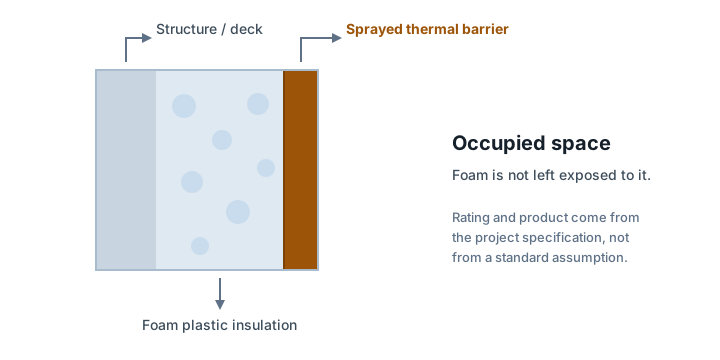
The covering is the big one. Foam plastic generally cannot be left exposed against an occupied space, and depending on the building, the assembly and the occupancy the project may require a thermal barrier, an ignition barrier or another specified system over the foam. That is a separate scope with its own material and its own labour, and a quote that omits it is not comparable to one that includes it. Ordinary spray foam insulation is not fireproof — the covering is what provides protection, specified for that assembly.
Scheduling is the other. Work that has to happen around an operating business, or between other trades on a construction site, costs more than work in an empty building. Sections done in stages so an operation keeps running, or out-of-hours access, are real costs and should be discussed rather than discovered.
And on agricultural buildings the questions are different again: whether the space gets washed down, whether livestock are in it, whether it is heated all winter or only when somebody is working in it. Those change the recommendation more than square footage does.
Why sealing changes the arithmetic
One reason quotes vary so much is that contractors are not always solving the same problem, even on the same building.
A quote built around depth answers the question "how much insulation goes here". A quote built around air sealing answers "where is this building actually losing heat". They produce different scopes and different numbers, and on plenty of houses the second one is both smaller and more effective — the reasoning is in why air sealing beats R-value.
This shows up most clearly on attics. A top-up is cheap per square foot and easy to quote. Sealing the ceiling plane first is slower, harder to price from a drawing, and it is what determines whether the top-up was worth buying. A quote that includes sealing will look worse on paper against one that does not, right up until the first cold snap. The order that actually works is set out in sealing an attic before you insulate it, and it is what attic work with us involves.
So when you compare, check what each quote is trying to achieve, not just what it costs. Two numbers for the same building can be answers to different questions.
What a written quote should actually contain
This is the list I would want if I were the customer, and it is what we put on ours.
The areas being treated, named specifically rather than as "the basement". The material for each, as closed cell or open cell. The target thickness for each area in inches. What preparation and protection is included. Whether removal and disposal of existing material is included, and of what. Whether any covering over the foam is included or excluded. Anything explicitly not included, so the exclusions are visible rather than implied.
It should also say what happens if something is found once work starts — a rotten sill, water in a crawl space, live knob-and-tube in an attic — because on retrofit work that is not a remote possibility.
None of that is unusual or onerous. It is a page. But a quote written that way can be compared with another quote written that way, and a quote that is a single line and a number cannot be compared with anything.
What we do not charge for
Worth stating plainly, because it varies between contractors and it affects what a quote is really costing you to obtain.
The assessment visit is free, including the travel, and including the times it ends with us recommending nothing at all. The written quote is free, and it stays free if you take it to somebody else — that is what it is for. There is no charge for a second visit if the scope changes or if you want something looked at again before deciding.
What we do not do is credit an assessment fee against the job, because there was never a fee to credit. That arrangement quietly prices the visit into the work and makes it harder to walk away, which is the opposite of what a free quote is supposed to achieve.
None of that is unusual in this trade and I am not claiming it as a distinction. It is simply worth checking, because a quote obtained for nothing and a quote obtained for a fee are not the same thing when you are comparing three of them.
What we do instead of quoting from a description
The assessment takes as long as the building takes, which on a house is usually under an hour. We look at the assembly, the cavity depth, the substrate, the moisture exposure, the access and how the space is used, and then we tell you what we think and why.
Sometimes that conversation ends with a recommendation to do less than you were expecting. Sometimes it ends with something we cannot help with — a drainage problem, a mechanical problem, a fan ducted into the attic. Either way you get an answer rather than a figure.
There is no charge for the visit or for the written quote, and that applies across the whole county — Barrie, Innisfil, Orillia, Midland, Alliston, Bradford, Collingwood and Wasaga Beach. We keep the travel honest by staying close to home, which is part of why the visit costs nothing.
If you are gathering quotes, ask us for one and hold it against the others. The specific things to compare are in this article, and they are the same four whether or not one of the quotes is ours. Tell us what the building is doing and we will come and look.
The short version: Compare thickness, material and what is included — not the headline number. A quote that names none of those is not really a quote, and the difference between two prices is usually a difference in scope rather than in value.