There is a version of this trade where the answer is always foam, the quote is always the whole envelope, and the assessment is a formality on the way to a number. It is not hard to spot from the outside: the recommendation arrives before anybody has measured anything.
The list below is the other half of the job — the situations where I end up recommending something cheaper, something smaller, or occasionally somebody else entirely. None of it is false modesty. Every one of these has cost me work at some point, and every one of them has also brought work back later.
When the cavity is regular, dry and accessible
A standard stud bay, framed on regular centres, in a wall that is neither damp nor shallow, with nothing complicated running through it. That is precisely what fibreglass batts were designed for, and in that cavity they do the conducted-heat job exactly as advertised for considerably less money.
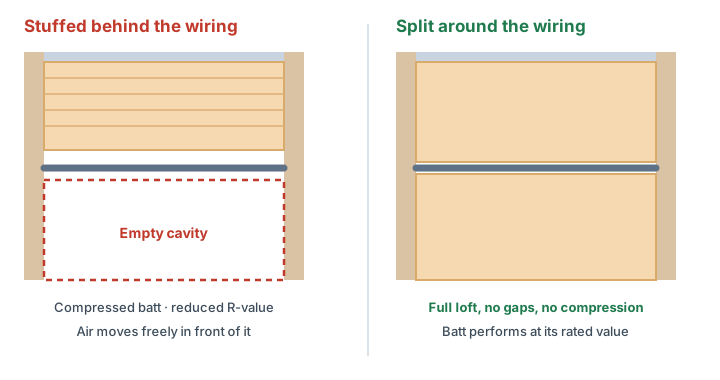
The word doing the work in that sentence is "properly". A batt jammed into a cavity, compressed behind wiring, cut short at the top, or bulging around a pipe is worth a fraction of the number on its label — not because the product is bad but because insulation only performs when it is in full contact with the space it is filling, with no gaps for air to move through.
That is genuinely the whole story with batt insulation. Cut to fit rather than forced. Split around services rather than squashed behind them. Full contact at the top and the bottom. Do that and a batt wall performs; skip it and no amount of R-value on the packaging saves you.
So when somebody asks me to quote foam for a new build with regular framing and a defined budget, quite often the honest answer is batts throughout and foam only where the framing gets awkward. That is a smaller invoice and a better use of the money.
When the real problem is a hole rather than a lack of insulation
I get called to houses with one room that will not hold heat, and every so often the answer costs almost nothing.
A bathroom fan ducted into the attic instead of out through the roof. A dryer vent that came apart behind the drywall years ago. A chase left open from the basement to the ceiling when somebody removed a chimney. Missing baffles at the eaves letting wind blow straight through the insulation at the perimeter. A cold-air return that was never connected properly.
None of those is an insulation deficiency, and no amount of foam fixes them, although foam will happily hide them. If that is what is going on I will tell you what it is, and if it is not our trade I will tell you who to ring.
This is also the most common reason a job turns out smaller than the caller expected. The full explanation of why the thing you notice and the thing causing it are rarely in the same room is in why air sealing beats R-value, and it is the single most useful idea in this whole set of articles.
When the wall wants to be left alone
Older buildings were frequently built to dry through the assembly. Water gets in — driven rain, condensation, a bad sill detail — and it leaves again because air and vapour move through the wall. That is not a design flaw. It is how a great many century houses have survived a century.
Fill that assembly with something that stops air and vapour and the drying stops with it. The wall does not tell you immediately; it tells you in five or ten years, at the sill plate or the bottom of a stud, by which time the work is long paid for and forgotten.
So on a house of that era I will often recommend doing nothing at all to the walls, and putting the money into the attic and the basement instead, where the return is larger and the risk is smaller. That is a smaller job and it is the right call. Where a wall genuinely does have to be done — usually because it is already open for other reasons — the questions are which side it dries to, what the sheathing is, and whether there is anything behind the cladding letting it drain.
This comes up constantly on the older stock in Orillia and around the downtown of every town in the county. The reasoning behind it is set out at more length in what I check before anything gets sprayed.
A contractor who recommends the same product on every single building is not assessing anything.
When the budget will not stretch to doing it properly
Half a spray foam job is often worse value than a whole batt job, and that is worth saying plainly because it runs against the obvious sales instinct.
If the budget covers foam in one of the three places that need attention, and the other two carry on leaking, the money has largely gone into a section of wall that was not the problem. The building is barely different and the budget is gone.
In that situation I would rather quote the sequence than take the whole budget for a partial fix. What to do first, what can reasonably wait a year, what can wait five. Nobody has ever been annoyed with me for that, and a fair number of those staged jobs have come back for the second and third stage later.
Staging works particularly well on conversions, where the building needs a lot doing and none of it is urgent in the same winter. Bottom and top first — crawl space and ceiling plane — then the transitions where an addition meets the original building, then walls last and often only where they are open anyway.
When the answer is a smaller job in a specific place
A good share of the calls I take describe a whole-house problem and turn out to be a boundary two metres long.
On houses built in the last fifteen or twenty years, the insulation in the walls is generally present and generally correct. What is missing is continuity — at the rim joist, at the garage ceiling under a bonus room, where a cantilever hangs out over open air, where a bulkhead runs through a cold space. Small areas, a fraction of the total, and between them the reason one room behaves differently from the rest of the house.
Quoting the whole envelope in that situation would be charging for insulation that is already in the wall. The targeted version is frequently half a day and a fraction of what people brace themselves for, and the rim joist on its own is the best-value few hours in most houses of that age.
If the assessment does find something larger, I will say that too, and put the reasoning in writing alongside it. The point is not that jobs are always small. It is that the size should come out of looking rather than out of a default.
When the attic needs emptying before it needs filling
People ask for a top-up because a top-up is what gets advertised, and on plenty of attics a top-up is exactly wrong.
What is already up there has history. Batts over blown material over the original shavings. A section that got wet at some point and never properly dried. Insulation rodents have rearranged into a series of tunnels. Material that has settled to two-thirds of its original depth and is no longer doing what its label said thirty years ago.
Blowing another foot over the top of that buries the problem and makes it more expensive to deal with later. Sometimes the recommendation is removal and disposal first, then sealing, then new material — which is a bigger job than the caller wanted, and I would rather say so than quote the cheap version and let somebody discover it in five years.
The reverse also happens. An attic in reasonable condition, with a leaky ceiling underneath it, does not need anything removed at all — it needs the ceiling plane sealed and then topping up. Telling those two situations apart is what the visit is for, and the sequence either way is in seal the attic before you insulate it. Whichever it turns out to be, it falls under attic insulation rather than a foam job.
When it is not an insulation problem at all
Occasionally the honest answer is that the building needs a different trade first.
A crawl space with standing water in it does not need insulating; it needs the water dealt with, and then insulating. A roof leaking at a flashing detail needs the flashing sorted before anybody bonds foam to the underside of the deck. A house with a heating system that is undersized, badly balanced, or dumping most of its output into a duct run through an unheated space has a mechanical problem that insulation will improve but not solve.
A rotten sill plate is the one that changes a job most often. Foam needs something sound to bond to, and spraying over rot buries a structural problem rather than fixing it. When we find that, the sequence becomes carpentry first and us second.
None of this is a reason to avoid the assessment — it is an argument for having one. Twenty minutes with a torch has changed the scope of a job more than once, always in the direction of doing things in an order that works.
What this looks like on a commercial job
The same principle applies on commercial and agricultural work, but the failure mode is different. Nobody is being sold a whole envelope they do not need; they are being quoted an assembly that does not match the specification.
The most common version is a quote for insulation with no mention of the covering. Foam plastic generally cannot be left bare against an occupied space, and depending on the building and the occupancy the assembly may require a thermal barrier, an ignition barrier or another specified system over it. That is a separate scope of work with its own cost, and if it is missing from a quote the quote is not comparable to one that includes it.
It is also where I am most careful with language. Spray foam insulation is not fireproof, and I would treat any contractor who says otherwise as either careless or selling. Fire protection is what the covering does, specified for that assembly, and where engineering, product documentation or approval from the building authority is involved those get established before work starts.
On agricultural buildings the thing more often missing is a question about the operation — whether the space gets washed down, whether livestock are in it, whether it is heated all winter or only when somebody is working in it. Those change the recommendation more than the square footage does.
When somebody else has already sprayed it
A steady trickle of calls are about foam that is already in the building, usually because something is not right and nobody will say what.
Occasionally the answer is straightforward: it was sprayed too thin, or it missed sections, or it pulled away from the framing as it cured. Those are visible and fixable, and adding to existing foam is generally possible if the surface is sound and clean.
More often the honest answer is that the material is fine and the problem is somewhere else — a leaking ceiling above a well-insulated wall, or a mechanical issue that was always going to leave one room cold. Foam gets blamed for things it was never asked to do.
And sometimes what I find is an assembly that has been sealed in a way that removed its drying path, which is a much more serious conversation and not one that can be fixed by adding material. What I will not do is guess about somebody else's work from a photograph. If foam already in your building is worrying you, have somebody look at it — the visit costs nothing and an honest answer is worth more than a second opinion delivered from a distance.
Why I bother saying any of this
Partly because it is the right thing to do, and partly because this is a small county. Barrie, Innisfil, Orillia, Wasaga Beach and the towns between them are not an anonymous market. Word travels, and it travels faster when somebody feels sold to. Nearly all of our work comes from people who were recommended by somebody else, which makes a short-term win from over-quoting an expensive mistake.
The other reason is more practical. A contractor who recommends the same product on every single building is not assessing anything. They have a truck full of one material and an incentive, and you should be a little suspicious of that — including when it is us.
The test I would apply as a customer is simple: ask what the alternative would do differently, and why it was ruled out. Anyone who has genuinely assessed your building can answer that in a sentence or two about the assembly. Anyone who cannot is quoting from a template.
If you want that kind of answer for your own building, tell us what it is doing and we will come and look. The visit and the written quote are both free, including — and this is the whole point of the article — when the recommendation turns out to be a smaller job than you expected, or no job at all.
The short version: If a contractor recommends the same material for every building they look at, they are not looking very hard. Ask what the alternative would do differently and why it was ruled out.