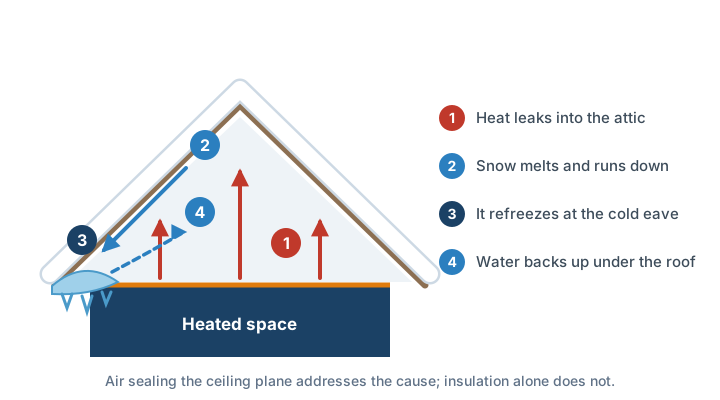
What is actually happening up there
Warm air leaks out of the house into the attic. It warms the underside of the roof deck. Snow sitting on the warmed part of the roof melts, even though the air temperature outside is well below freezing.
That meltwater runs down the slope until it reaches the eave — the overhang, which has nothing heated underneath it and stays at outdoor temperature. There it refreezes. Do that for a few days and you build a ridge of solid ice across the bottom of the roof.
Now the dam does the damage. Water coming down behind it has nowhere to go, so it pools, backs up under the shingles and finds its way inside. Shingles shed water running downhill; they were never designed to hold back a pond, and no shingle ever manufactured is.
Everything about the fix follows from that sentence. The ice is a symptom of a warm roof deck, and the roof deck is warm because the ceiling below it is leaking heat. Deal with the heat and the mechanism stops.
The tells, and what each one points at
Ice dams announce themselves in fairly specific ways, and the pattern usually narrows down where the heat is coming from before anybody goes into the attic.
Why the usual fixes disappoint
Three things get tried before anybody rings us, and it is worth explaining why each one falls short rather than simply saying it does.
New shingles do not stop it. They may buy a season, and the ice will still form, because nothing about the heat has changed. Ice and water membrane under the shingles is genuinely worth having and it limits the damage when a dam does form — but it is a seatbelt, not brakes. A roof detailed that way still gets the dam; it just survives it better.
Heat cables melt a channel through the ice and cost money to run every time it is cold. On some roofs, with awkward geometry and no practical alternative, they are a reasonable last resort. They are not a repair, and they tend to move the problem to wherever the channel discharges.
And adding more roof vents is the one I see most often. The logic sounds right — more airflow, colder deck. But ventilation cannot outrun a leaking ceiling, and in some cases it makes matters worse, because the extra exhaust helps draw warm air up through the holes. If somebody has added a ridge vent or a couple of turbines and nothing improved, that is the reason.
Where the heat is getting in
It is nearly always the same short list, and none of the items are exotic.
The attic hatch, if it is a loose panel with a batt on top. The gaps at the top plates where interior walls meet the attic, running the length of every wall in the house. Plumbing stacks and duct chases passing through the ceiling plane. Bathroom and kitchen fans discharging into the attic instead of out through the roof. Recessed lights. The void above a dropped ceiling or a bulkhead.
Then there is the perimeter. If the insulation has slumped into the eaves, or the baffles are missing, wind blowing in at the soffit strips heat out of the insulation right where the roof needs to stay coldest. That produces dams even in houses where the rest of the ceiling is in decent condition.
The full sequence for dealing with all of it — what gets sealed, in what order, and why depth comes last — is in sealing an attic before you insulate it. The underlying principle, that air movement matters more than R-value, is in why air sealing beats R-value.
What does fix it
Seal the ceiling plane so the warm air stays in the house. Insulate properly on top of it, with the eaves baffled so the airflow stays clear and the insulation does not slump into the soffits. Get the fans and any ducting out of the attic and discharging outside.
The aim is a cold, evenly cold roof deck, so that the snow up there behaves the same at the ridge as it does at the eave. Achieve that and the dam has nothing to form from, because nothing is melting in the first place.
That is genuinely it. It is not a product, it is a sequence, and it is the same sequence whether the house is a bungalow in town or a farmhouse on a concession road. What varies is how much of it a given building needs, which is what an attic assessment is for.
One thing worth saying plainly: this is not usually a whole-house job. On a lot of houses the dam is being driven by three or four specific leaks, and dealing with those is a day rather than a project.
The ice is a symptom of a warm roof deck, and the roof deck is warm because the ceiling below it is leaking heat.
The other damage, the kind you do not see
Water coming through a ceiling is the version everybody notices. There are three quieter ones that cost more over time.
The first is inside the wall. Meltwater backing up over the top plate frequently runs down the inside of an exterior wall rather than dripping into the room. It wets the insulation, which stops performing while it is wet, and it wets the framing. You may get a stain at the top of the wall months later, or nothing visible at all until something is opened up.
The second is the insulation itself. Wet blown insulation compacts and does not recover. An attic that has been repeatedly wetted at the perimeter can be several inches shallower at the edges than it was when installed, which makes the next winter worse than the last — the problem compounds rather than repeating.
The third is the roof structure. Sustained wetting of sheathing and rafter ends is a slow problem, but it is a structural one, and it turns an insulation job into a carpentry job. That is the main reason I treat a described dam as worth looking at promptly rather than in the spring.
None of this is an argument for panic. It is an argument for dealing with the cause once rather than the symptom annually, which over a few winters is also the cheaper option — the framing for that decision is in what actually drives the price of a job.
Cathedral ceilings are the harder version
Everything above assumes an open attic, where there is space to get at the ceiling plane. A cathedral or vaulted ceiling puts the roof and the ceiling in the same assembly, and that changes the problem.
There is very little depth. A rafter gives you what it gives you, a vented assembly needs part of that kept clear for airflow, and the insulation is fighting for the rest. Compress a batt against the sheathing and it loses R-value exactly where the deck needs to stay cold. Leave a gap at the ridge or around a beam and air short-circuits the whole run.
Because the warm side and the cold side are so close together, these assemblies dam earlier and more reliably than open attics do. They are also the hardest to inspect, since there is no space to get into.
The two ways out are an unvented assembly with closed cell foam bonded to the underside of the deck, or a hybrid with a flash coat of closed cell and batt below it. Which suits depends on the roof covering, the framing depth and what sits above — the reasoning is in closed cell or open cell. This is common enough in chalet architecture that it comes up on most of the recreational properties we look at around Collingwood.
Why this is worse on the Georgian Bay side
The physics are the same everywhere. The consequences are not.
The snow belt off Georgian Bay produces both heavier accumulation and longer sustained cold than the south of the county sees in an average winter. More snow on the roof means more material available to melt and refreeze. Longer cold means the dam that forms in January is still there in March, growing rather than releasing.
Freeze-thaw cycling further south is, oddly, more forgiving — a dam that forms and then melts out during a mild spell does less damage than one that sits and builds for two months. Around Midland, Penetanguishene and along that shoreline, a marginal roof assembly gets found out every single year.
It also means the damage arrives as water inside the building rather than as a higher heating bill. That is the practical reason I treat ice damming as urgent when somebody describes it, and a cold room as merely worth looking at.
Moisture is the other half of the same problem
Warm air leaking into a cold attic does not only carry heat. It carries water vapour, and the vapour causes its own trouble once it gets there.
Showers, cooking, laundry and simply breathing put a substantial amount of moisture into the air of an occupied house. When that air escapes through the ceiling and meets a cold roof deck, the moisture condenses — and in a Simcoe County January it does not condense, it frosts. Come the first mild spell it melts, and it drips onto the insulation below.
People report that as a roof leak, and it is not. A genuine leak follows the weather; frost melt follows the temperature, so it appears on a mild bright day rather than during rain. That distinction is worth knowing before anybody starts pulling shingles up looking for a hole that is not there.
The fix is the same fix. Seal the ceiling plane, keep the vent path clear, and get the fans discharging outside. Both the heat and the moisture are travelling on the same air, and stopping the air stops both. The broader version of that argument — how insulation changes where moisture ends up — is in what I check before anything gets sprayed.
Snow on a roof is a free diagnostic
There is one advantage to a winter here: the building shows its hand, and you do not need any equipment to read it.
Snow on a roof is a thermal image. An evenly covered roof is a well-sealed, well-insulated one. Melted patches, a bare strip along the ridge, ice starting at one eave and stopping at a gable, a clean line partway up the slope — all of it points somewhere, and none of it is visible in July.
So if a roof or an attic has been on your list, booking a look in the coldest part of the year is not a bad idea even if the work happens later. Photograph what the snow is doing before it goes, from the ground, and it will still be useful evidence in April.
Working through a Simcoe County winter is normal for us. Attic work in particular goes better in cold weather than in an August attic at forty-five degrees, so the season that produces the problem is also a reasonable season to deal with it.
Gutters, and what they have to do with it
People often ask whether the gutters are causing it, usually because that is where the ice is most visible.
They are not the cause. A dam forms on the roof surface above the eave whether there is a gutter there or not, and removing the gutters does not stop the melt-and-refreeze cycle. What a full, frozen gutter does is give the ice a head start and a place to anchor, so it makes an existing dam worse rather than creating one.
Keeping gutters clear before winter is worth doing for ordinary reasons, and it does slightly reduce how quickly ice builds. It is maintenance, not a fix, and I would not want anybody spending on gutter work in the belief that it addresses the cause.
The same applies to snow rakes. Pulling snow off the lower part of the roof removes the material the dam is made of, which genuinely helps in a bad winter, but the roof deck is still warm and the moment it snows again the process restarts. Both are ways of living with the symptom, and the case for dealing with the cause instead is largely about not paying for the symptom every year — the arithmetic is in what actually drives the price of a job.
What to do if you have one right now
In the middle of an active dam, the immediate priority is limiting damage rather than solving the cause, and the two get confused.
Do not go up on an icy roof, and be wary of anybody who offers to chip a dam off with a hammer — it is a straightforward way to destroy shingles and put water where it was not going. If the water is actively coming inside, catching it and getting a professional to clear the ice safely is the short-term answer.
What I would not do is commit to a roof replacement on the strength of one bad February. Replacing the covering without dealing with the heat means paying for a new roof and keeping the dam, and I have seen that sequence more than once.
The cause can be looked at any time, including while the ice is still there — in fact that is the most informative moment, because whatever is driving it is currently visible. Tell us what the roof is doing and we will come and find out why rather than guessing from the ground.
The short version: If your roof is making ice, look under the roof. Snow on a roof is a thermal image of the house, and it is pointing at something — usually three or four specific holes in the ceiling rather than the whole building.